
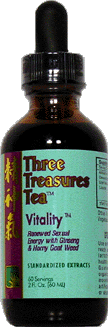
Vitality is an important tea for men and women to increase kidney Qi, the foundation of sexual energy and long life. This powerful formula also contains a balance of herbs to enhance immune function and support cardiovascular health.
|
Vitality Standardized herbs included in this Traditional Chinese formula include Tribulus Terrestris, Dong Quai, Knotweed, Cayenne Pepper, Panax Ginseng, Licorice, and Horney Goat Weed. A daily cup of delicious tea, served hot or cold, can provide phytonutrients to help fight fatigue and dramatically improve circulation. In the Chinese tradition, the balance of herbs in Vitality™ Tea nourishe yang to improve Blood and Qi - the essence of sexual energy. Unfortunately, No Longer Available |

Take this highly effective Vitality formula when you encounter impotence and low kidney energy, including low back pain and fatigue. Dong Quai nourishes the blood and, in combination with Knotweed and Cayenne Pepper, improves blood flow. Panax Ginseng and Licorice promote Qi circulation. Horny Goat Weed nurtures the kidneys. Yohimbe increases blood flow to the sexual area. This well balanced formula nourishes both yin and yang and improves both Blood and Qi, as well as helping the immune system and balancing hormones in the body.
Vitality can also help when you encounter fatigue, impotence, or other symptoms of low kidney energy. Helps with chronic fatigue. Nourishes the blood and improves blood flow. Helps with low sexual energy.
Use For: Chronic Fatigue, Fatigue, Kidneys, Qi (enhance), Sexual Energy (men)
The information is not intended as medical advice, but only as education and as a guide in working with your health care professional.
Organ Affinity: Liver, Kidneys
Effects: Tonic to Kidney-Yang; eliminates wind-damp ailments (rheumatic); aphrodisiac
Indications: Kidney-Yang deficiency, impotence, spermatorrhea, premature ejaculation, lumbago, cold hands and feet, fears of cold, rheumatic discomforts of "wind-damp" excess, spasms; numbness.
Remarks: Dilates the capillaries and large blood vessels, lowers blood pressure.
1. Wang J et. al. [Effects of Epimedium sagittatum on soluble IL-2 receptor and IL-6 levels in patients undergoing hemodialysis]. [Chinese] Chung HuaNei Ko Tsa Chin 1995 Feb; 34(2): 102-4.
2. Shen CC et. al. "New prenylfiavones from leaves of Epimedium sagittatum." J Nat Prod 1996 Apr;59(4):4 12-4
3. Liao HJ et. al. [Effects of Epimedium sagittatum on quality of life and cellular immunity in patients of hodialysis maintenance]. [Chinese] Chung Kuo Chung His I Chie Ho Tsa Chin 1995 Apr; 15(4):202-4
Organ Affinity: Liver & Spleen
Effects: Tonic to blood; emennagogue; promotes circulation; analgesic, sedative, laxative.
Indications: Menstrual disorders; dysmenorrhoea, menorrhagia, amenorrhoea, blood deficiency: painful scarring in traumatic injuries, postnatal abdominal pain; rheumatic pains.
Remarks: Best herb for menstrual disorders. Strengthens female reproductive organs and regulates hormonal levels. Also, used as a liver remedy, circulatory stimulant and blood fortifier. Eases the effects of menopause.
1. Addition of methyl thioglycolate and benzylamine-60 (Z)-ligustilide, a bioactive unsaturated Lactone constituent of several herbal medicines. An improved synthesis of (Z)-ligustilide. J Nat Prod 58:1047-55, Beck JJ& StermitzFR.
2. Lou, Z. H. "Abnormal menstruation and pre-menstrual syndrome." Journal ofNew Traditional Medicine, Kwang Chow TCM College, 5,47-48,1984.
3. Kumazawa, Y., Mizunoe, D., and Otsuka, Y. "Immunostimulating polysaccharides separated from hot water extract of angelica acutiloba Kitagawa (Yamato Tohki)." linmunology, 47,75-83, 1982.
4. Yoshira, K. "The physiological actions of tang kuei and cnidium." Bulleting of the Original Healing Arts Institute, 10, 269- 278,1985.
5. Haranaka, K., Satomi, N., et al. "Antitumor activities and tumor necrosis factor producibility of traditional Chinese medicines and crude drugs." Cancer Inimunol. Immunother.,21(1), 1-5, 1985.
6. Xu, L. N., Yin, Z. Z. and Lin, M. "The antithombotic effect of Dang Gui (angelica senensis) injection and its clinical trial." In Abstracts of International Symposium on Traditional Medicine and Modern Pharmacology, Beijing, 1986, p. 104.
Organ Affinity: Kidney
Traditional use in Chinese Medicine: Tonic to kidneys, kidney deficiency: lumbago, weak bone, constipation due to dry intestine, swelling of lymph glands, abscissa and ulcers, analgesic. Expels "damp-wind", moist, eases blood flow (menstrual disorders), candida, sore throat, cough, and clear phlegm.
Remarks: Anti-inflammatory (arthritis), anti- bronchitis, fever due to lung infection, anti microbial and anti-viral.
Recent scientific findings: Polydatin thins blood, inhibits effect of platelet aggregation, reducing effect on arterial thrombosis, prevents endotoxin-induced acute lung injury, enhances antioxidaiton and protects against multiple organ failure. Anthraguinones (emodin, danthron, physcion and rhein) are active anti- inflammatory compounds against arthritis and anti-microbial activity.
1. Polydatin prevents endotoxin-induced acute lung injury in rats. Chung Hua Chich Ho Ho Hu His Tsa Chili 16:153-4, 1993. Mo Gy etc.
2 Emodin, a protein tyrosine kinase inhibitor for Polygonum cuspidatum. J. Nat Prod 55:696-8, 1992, by Jayasuriya H, Koonchanok NM, etc.
3. An invivo investigation of the effect of anthraquinones on the turnover of aggrecans in spontaneous osteoarthritis in the guinea pig. Inflamm Res 44:182-6, 1995. Carney SL, Hicks CA, Tree B and Broadmore RI.
4. Activity of Anthraquinonic and naphthoquinonic compunds on oral bacteria. Phannazie49:681-3, 1994. Didry, Dubreuil L and Pinkas M.
5. Evaluation of the antiviral activity of anthraqauinones, anthrones, and anthraquinone derivative against human cytomegalovirus. Antiviral Res 17:63-77, 1992.
Effects: Boosts energy, immunity and sexuality; strengthens male reproductive organs, adrenal glands; improves the body's abiltiy to handle stress.
Indications: Energy deficiency, weak pulse; asthma due to "empty" lungs; diabetes, heart palpitations, lack of appetite.
Remarks: Regulates blood pressure and blood sugar, promotes secretions of sexual hormones in men and women and promotes blood production.
1. Takagi, K., "Pharmacological studies of Panax ginseng root." Japanese Journal of Pharmacology, 22,245-259, 1972.
2 Kim, E. C., Cho, H. Y. and Kim, J. M. "Effect on Panax ginseng on the central nervous system." Korean J. Pharmacol., 2, 23,-28, 1971.
3. Saito, H., Yoshida, Y. and Takagi, K. "Effects of Panax ginseng root on exhaustive exercise in mice." Japanese Joumal ofPhannocology, 24, 119-127, 1974.
4. Breckham, I. I and Dardymov, I. V. "New substances of plant origin which increases non specific resistance." Annual Review of Pharmocology, 9,419-430, 1969.
Effects: Tonic; antipyretic, antidote; demulcent to lungs; expectorant; analgesic. Indications: "Empty" spleen and stomach; blood and energy deficiency; toxic excess; swollen and sore throat; coughs; asthma; acute abdominal pains.
Remarks: Most common Chinese herb. Has benefits for all organs; good taste; slows and prolongs the effects of the strong tonic prescriptions; emollient in peptic ulcers.
1. Pazmar, S.S. et. al. "Biochemical basis for anti-inflammatory effects of glycyrrhetc acid and its derivatives.: mt. Cong. Bio Chem., 6(5),410-1964.
2. Zhao, M.Q. et.al. "The preventive and therapeutic actions of glycyrrhizin, glycyrrhizin acid and crude sailkosides on experimental cimhosos in rats." Yao Hsueh HsuehPao, 18(5),325-331, 1983.
3. Anderson, D.M. and Smith, W. G. "The antitussive activity of glycyrrhetic acid and its derivatives." J. Pharm, Pharmacol., 13,396-404,1961.
4. Takagi, K. Watanebe, K. and Ishi, Y. "Peptic ulcer inhibiting activity of licorice root." Proc. mt. Phannacol. Meeting 7(2), 1015,1965.
5. Greenburg, H.B. et.al. "Effect of human leukocyte interferon on hepatitis B virus infection in patients of glycyrrhizic acid" Experienta, 36,304, 1980.

The Three Treasures: Jing, Shen, Qi describe three concepts of energy and underly the philosophy on which the "Three Treasures Teas" were developed.
The Three Treasures Teas: Sixteen formulas to balance and harmonize your body.